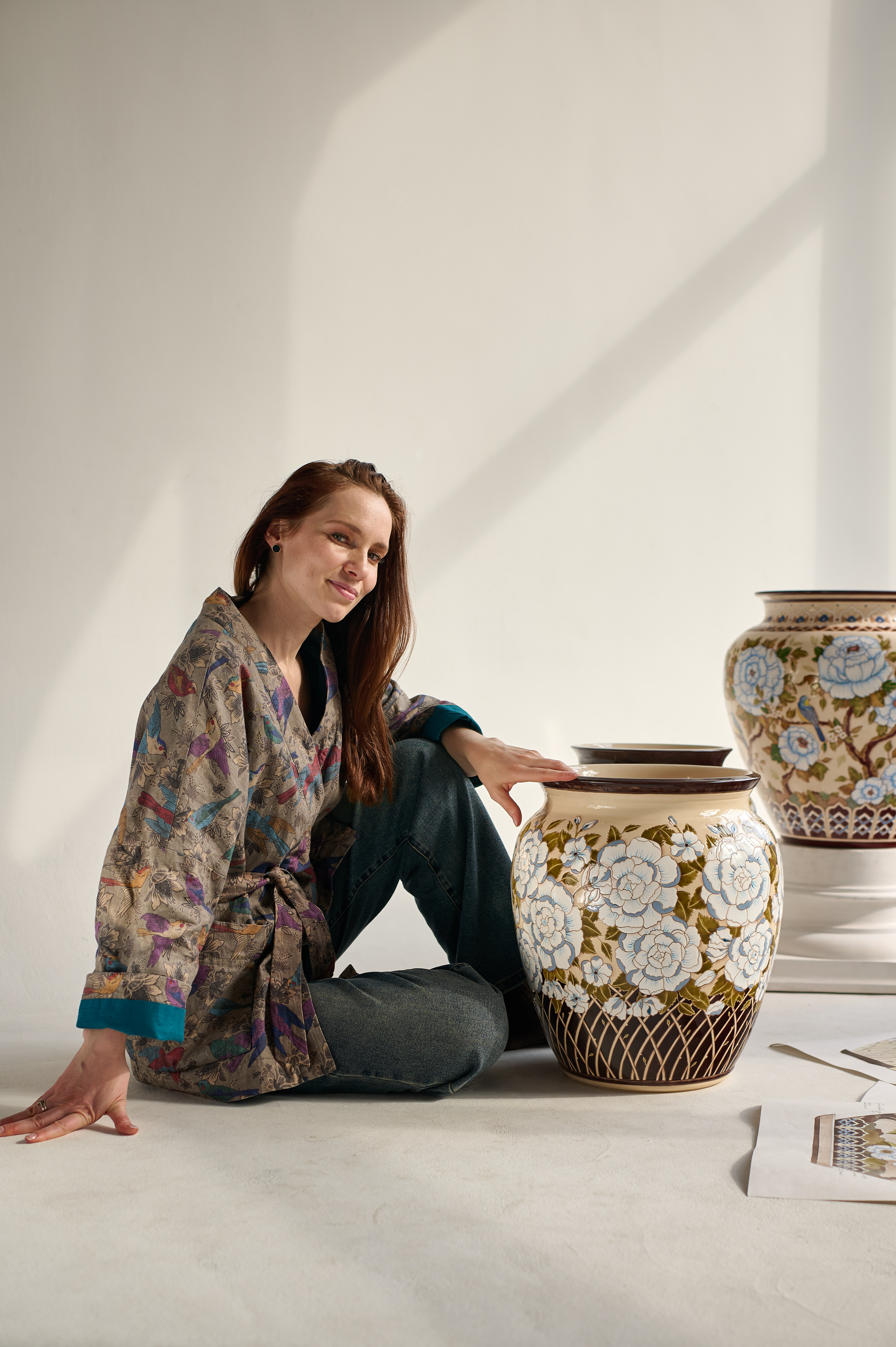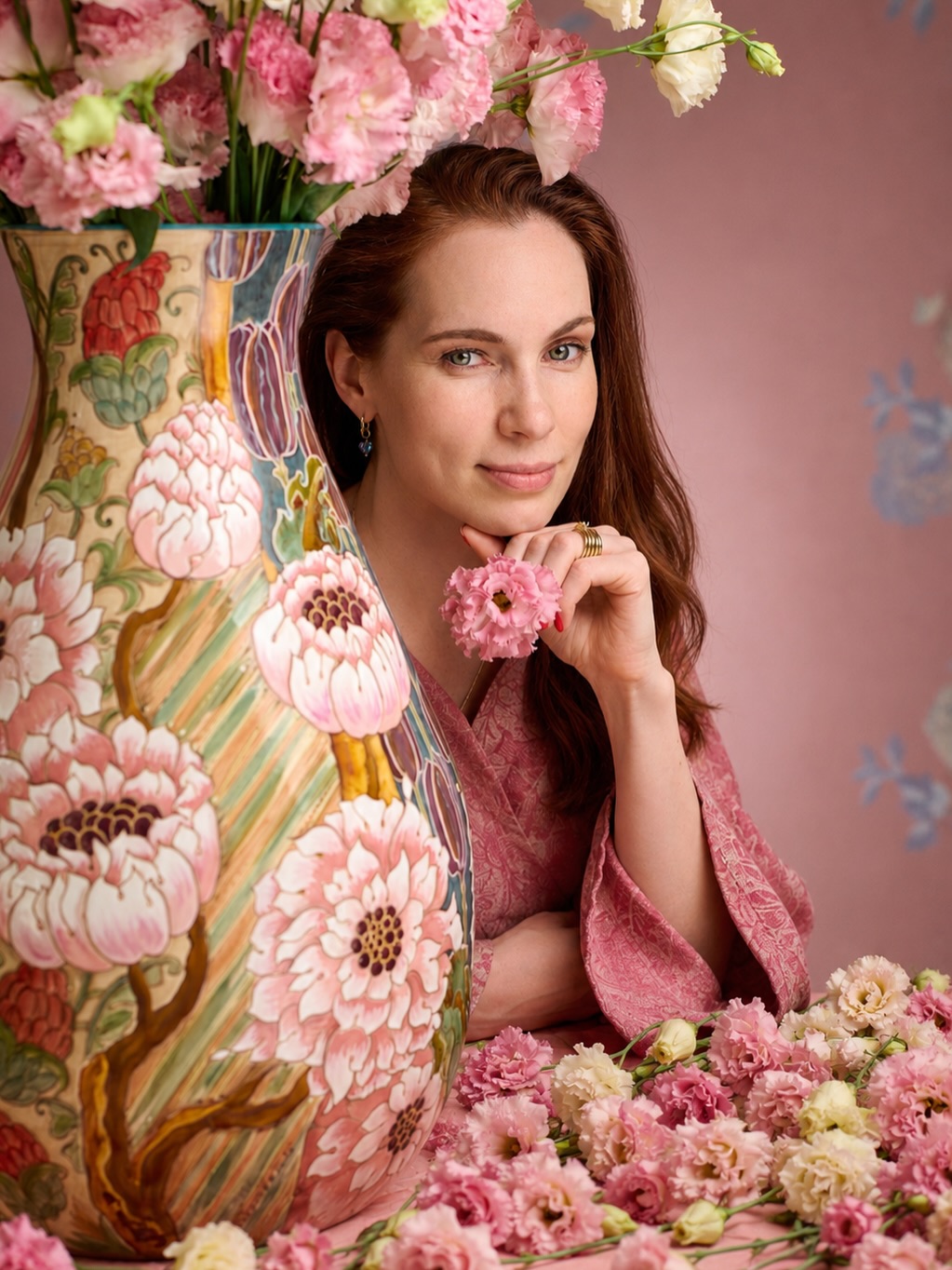
My practice is rooted in flowers, ornaments and patterns. These images may feel familiar to almost everyone, but for me they are first and foremost connected with memory.
In childhood, patterns were constantly present around us — on carpets, wallpaper, fabrics and tableware. We rarely paid attention to them, yet this visual environment quietly shaped our sense of beauty. I therefore see ornament not simply as decoration, but as a cultural trace — a link between personal memory, the past and the present.
Nature almost always appears alongside ornament in my work. Flowers, leaves, fruit and birds gradually intertwine with patterns, growing through them and becoming part of a single composition. I am interested in bringing together the natural and the man-made, the living and the decorative, the recognisable and the imagined.
Ceramics allows me to work not only with imagery, but with the surface itself. I use underglaze and overglaze painting, glazes and relief. Each work is built gradually, layer by layer, and passes through several firings. As a result, the image is no longer simply flat: the relief catches the light, glossy and matte areas shift depending on the lighting, and the surface itself becomes an active part of the composition.
I am also drawn to the contradiction within the material. Ceramics can survive for a very long time, while flowers, light, summer and memories are fleeting. I am interested in preserving something fragile and temporary in a material capable of outlasting the moment from which the work emerged.
After moving to Saint Petersburg, colour became especially important to me. In a city with long grey seasons, I found myself turning more and more towards saturated hues. Over time, vivid colour became not simply a feature of my palette, but a way of speaking about warmth, joy and a sense of life.
I want to create works that invite the viewer to return to them: first to perceive them as a whole, and then gradually to notice individual layers, details, textures and fragments of ornament.